
A useful real estate lead tracker connects each enquiry to a person, an accountable agent and a recorded viewing outcome. For a UAE agency owner, the first report should show how many new prospects reached a completed viewing, with enough evidence to explain every count.
Start with six stages and separate viewing appointments from the prospect record. A calendar booking proves that someone reserved a slot. Attendance needs its own confirmation.
Agree what each stage actually means
Stage definitions should describe something another team member can verify. Avoid labels such as “hot” unless you have written criteria for them.
Use this starting model for resale and rental enquiries. Adapt qualification fields to your agency's stock and process.
| Stage | Evidence needed | Common counting mistake |
|---|---|---|
| Enquiry received | Original message, form or recorded call entry with time and source | Counting a WhatsApp button click as a conversation |
| Assigned | Named owner and assignment time | Assuming a group notification creates ownership |
| Contact established | Prospect has replied or a conversation took place | Treating an unanswered call as contact |
| Qualified | Agent confirms requirements and a plausible match to available stock | Using nationality as a substitute for stated requirements |
| Viewing booked | Property reference, agreed time and participant confirmation | Counting an offered slot as a booking |
| Viewing completed | Agent records attendance and outcome | Moving every past appointment to completed |
Keep unsuccessful outcomes alongside the stages: invalid details, no reply, no suitable stock, prospect withdrew and duplicate. “No suitable stock” belongs in a different management conversation from “no reply”.
For off-plan enquiries, a project presentation or sales-centre meeting may be a useful milestone. Name it separately. Combining those meetings with visits to completed properties makes branch comparisons hard to interpret.
One person can have several enquiries and appointments
Keep a person record, an enquiry history and individual viewing records. Each has a different job.
The person record carries contact details, preferred language and communication preferences. The enquiry history preserves the requested property, original source and arrival time. A viewing record holds the property reference, scheduled time, attendance and feedback.
Hypothetical example: a buyer enquires about a Dubai Marina apartment through your website, then asks about a JLT listing on WhatsApp. An agent books two viewings for Saturday. Your report should show one new prospect, two enquiries and two appointments. If both happen, that is one prospect reaching a completed viewing and two completed viewing appointments.
Do not merge records just because names match. Normalise phone numbers into an international format and flag exact matches for review. Shared family numbers and assistants contacting agencies for clients need human judgement. Preserve each source entry when a merge is approved.
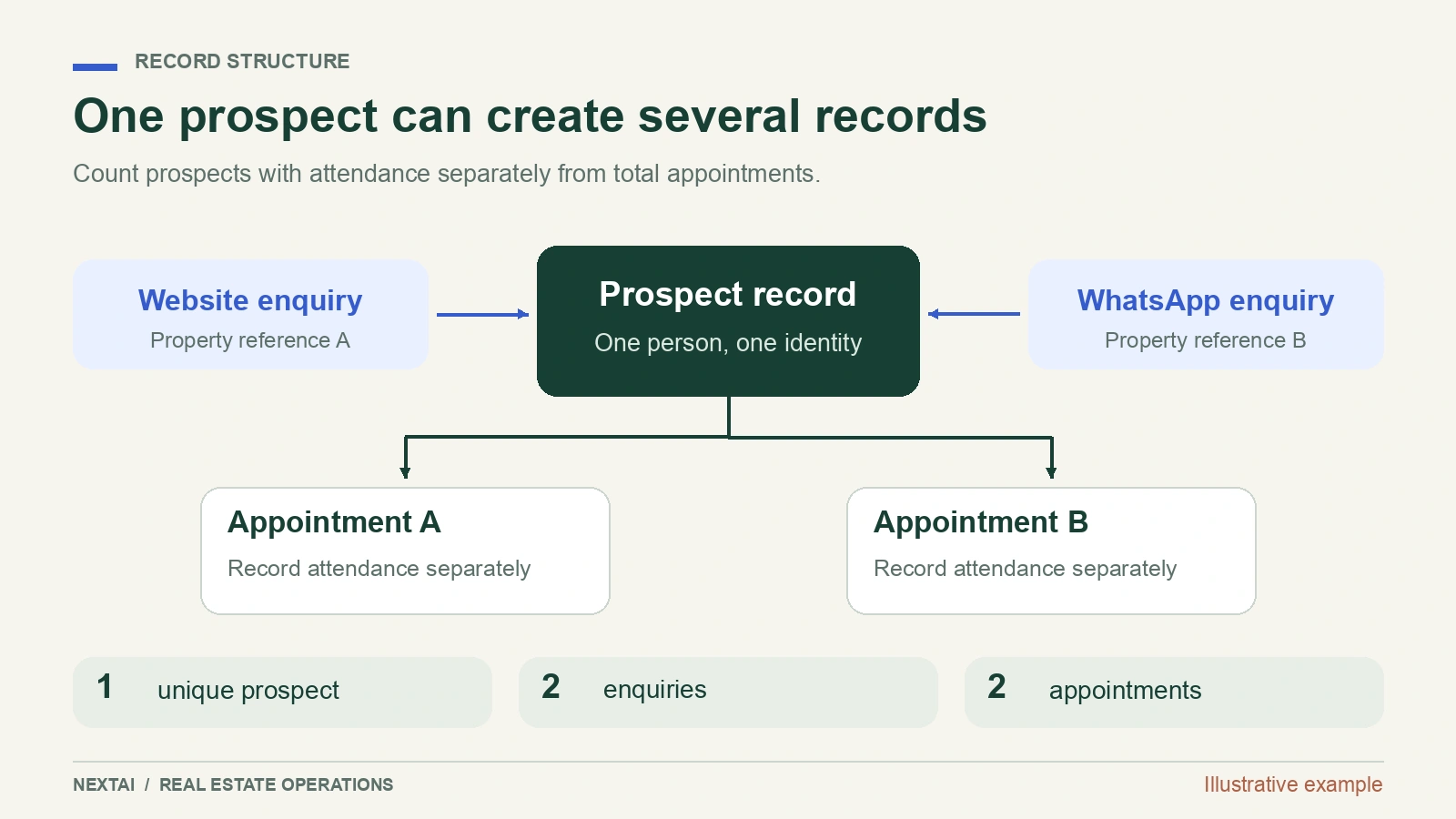
Proposed record structure. Enquiry volume, unique prospects and viewing appointments are separate measures.
Capture the minimum data at each handover
Require fields when the team needs them. A long first-contact form encourages incomplete or invented answers.
At arrival, capture the enquiry ID, timestamp, source, property or project reference and available contact details. Record campaign information when present. Keep “unknown” as an explicit source; silently assigning it to direct traffic creates false certainty.
At assignment, add the agent and assignment timestamp. At qualification, record purchase or rental intent, requested area, budget basis and timing. For Dubai rentals, write whether a figure is an annual budget and whether the prospect has stated cheque preferences. For purchases, distinguish the property budget from any wider budget discussion. These are proposed operating fields, not legal requirements.
At booking, create an appointment ID with a full date and time. Store the timezone too. Show “Dubai time” in confirmations to overseas buyers, and confirm what time works where they are staying.
After the appointment, require attended, cancelled, rescheduled or no-show. Capture a short reason and the next action. Rescheduling should preserve the old appointment history and link to the replacement. It must not create an attended viewing.
Keep acquisition source and recent contact separate
Preserve the first known acquisition source even when the conversation moves to WhatsApp. Otherwise, your most convenient communication channel will receive credit for work done by an advertisement, portal or referral.
For each person, store first known source, latest enquiry source and the supporting enquiry IDs. For each campaign report, write down the attribution rule. “First recorded source” is workable for an initial management report if its limitations are visible: it cannot reconstruct interactions your agency never observed.
Google provides offline conversion imports to connect advertising interactions to later business outcomes. Its offline conversion documentation explains the matching approaches. Your CRM still needs a reliable event and timestamp before there is anything useful to import.
For Google Ads, decide whether an attended viewing is a qualification milestone or your chosen converted-lead event. Google lets businesses define those steps in their own process through qualified-lead and converted-lead goals. Keep the internal event name explicit, such as “viewing attended”; do not label it “sale”.
Build a weekly report with a stable denominator
Use a cohort: prospects whose first recorded enquiry arrived during the same period. Track what happens to that group over time.
A simple report needs five columns: source, unique new prospects, contacted prospects, qualified prospects and prospects with at least one attended viewing. Add advertising spend only where you can match its period and source definition.
Hypothetical cohort: 80 unique prospects arrive during one week. By the review date, 48 have been contacted, 24 qualified and 12 attended a viewing. Contact rate is 48 / 80 = 60%. The enquiry-to-attended-viewing rate is 12 / 80 = 15%.
Separately, the diary may show 17 completed appointments because some of those 12 prospects visited several properties. That number helps measure workload. Using 17 as the prospect conversion numerator would overstate the result.
Put the review date beside every cohort. A recent week has had less time to progress than an older one. Keep operational reporting on appointments completed this week in a separate table so the sales manager can still plan staffing.
Reconcile ten records before adding more charts
Take a small sample spanning your main sources. Trace each record from its original enquiry through assignment to its latest outcome. Include a duplicate and a rescheduled appointment.
Ask the assigned agent to show the evidence for each stage. If the message says “perhaps Thursday”, the viewing is still proposed. If the prospect attended but the record is stale, fix the update habit before judging the channel.
Then review exceptions daily: unassigned enquiries, overdue next actions and past appointments without outcomes. The lead assignment rules explain who should receive an enquiry when the original owner is absent.
Once your counts reconcile, use them to calculate an affordable cost per lead. If the team cannot maintain these records in its current system, scope the required fields and handovers before commissioning CRM automation. A useful first deliverable is a report an agent and an owner can both explain, record by record.
PUT IT TO WORK
Make your viewing report traceable
Discuss the enquiry fields, agent handovers and viewing records your agency needs before choosing an automation.
Discuss your agency’s workflow Explore the service