
Give each enquiry one accountable owner, route it to an eligible agent and define what happens when that agent cannot act. Those decisions matter more than choosing a round-robin button in a CRM.
For a UAE real estate agency, start by separating the person who owns the client relationship from the person who must handle today's enquiry. They can be the same agent. A viewing, an absence or a request for a different language may require temporary cover without deleting the existing relationship.
The rules below are a proposed operating policy. They are not a record of client results or a universal response-time standard.
Resolve existing relationships before rotating new leads
Check whether the prospect already has an active relationship with the agency before assigning an enquiry to a new agent. Preserve the new enquiry even when it belongs to an existing contact.
Hypothetical example: a buyer working with an agent on a Dubai Marina purchase submits a JLT enquiry through another listing. The new message should reach the relationship owner, with the new property reference attached. If that agent is unavailable, a designated cover agent handles the enquiry and records the handover.
Agree what “active relationship” means. It could require an open requirement with a documented recent conversation and a scheduled next action. Choose the review period from your own operating cycle. A contact assigned two years ago with no current activity should enter manager review, not remain permanently locked to a departed broker.
An exact phone match is a reason to inspect the existing record. It is not permission to overwrite another person's details. Shared numbers and enquiries made by assistants need a review route.
Put the rules in a strict order
Resolve uncertain identity and conflicting ownership first, then evaluate the remaining rules in order. When a rule sends the enquiry to a named owner or manager review, stop automatic routing. Otherwise, two automations can each decide that a different agent owns the same enquiry.
| Order | Condition | Action |
|---|---|---|
| 1 | Contact identity is uncertain or two active owners conflict | Put in manager review with a named duty owner |
| 2 | Confirmed existing active relationship | Assign the action to the relationship owner or eligible nominated cover; otherwise use the duty manager |
| 3 | Enquiry concerns a specific property or project | Select agents authorised by your agency to handle that inventory |
| 4 | Check current coverage and any stated language or appointment requirement | Keep available agents with capacity who can meet the requirement |
| 5 | Several agents remain eligible | Distribute using the team's agreed rotation or capacity rule |
| 6 | No agent remains eligible | Assign the duty manager and create an exception task |
Use language requested by the prospect. Do not infer it from a name or nationality. Area expertise should reflect actual coverage, such as access to the unit and familiarity with that inventory, not an arbitrary postcode label.
A contact can also have more than one genuine requirement. Someone selling in Abu Dhabi while buying in Dubai may need separate opportunity owners. Keep the overall relationship visible and define who coordinates communications, so the client does not receive conflicting messages.
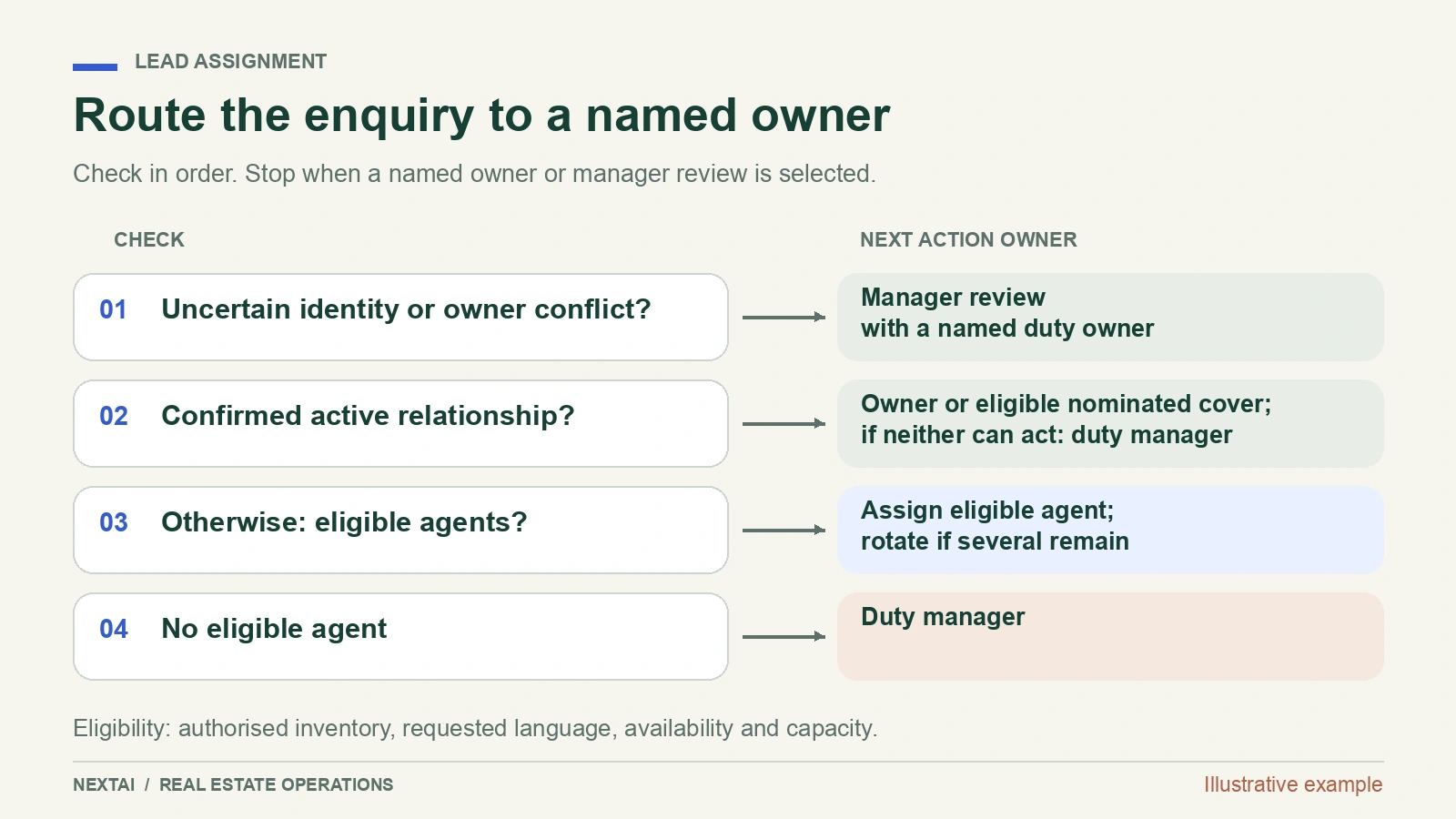
Proposed decision order. Every branch ends with a named owner, including the exception branch.
Define availability as an operating commitment
An agent who appears online may still be conducting a viewing. Your assignment policy needs explicit coverage status and an accepted workload definition.
Use available, temporarily unavailable and off duty as starting states. Give temporary absence an expiry or scheduled review. Require the duty manager to check the roster at the start of each covered period, including whichever evenings or weekends your agency has chosen to staff.
If you use capacity limits, count work that needs action. Total contacts owned is a poor measure when one broker has years of dormant records. A useful initial measure is active enquiries with a next action due during the current coverage period, adjusted for booked viewings.
Keep the first version easy to explain. Equal rotation among eligible available agents may be sufficient. Weighting by performance before you can measure assignment fairness risks rewarding agents who received easier enquiries.
CRM behaviour needs checking in the actual account. For example, HubSpot's owner-assignment documentation describes seat requirements and an option to overwrite existing ownership. Features also differ by record type. A sales contact, lead and support ticket should not be assumed to share the same routing controls.
Escalate missed acceptance without causing duplicate calls
Treat assigned, accepted and contacted as separate events. Assignment shows who has responsibility; acceptance shows that the agent has acknowledged it. Contact requires evidence of a conversation or reply.
Set an acceptance target for covered hours and test whether the team can meet it. A proposed ten-minute acceptance interval, for example, is an internal operating choice. It is not a claimed UAE benchmark or a promise of better conversion.
At expiry, check the activity record before changing ownership. If the agent is already handling the enquiry, alert the manager about the missing acceptance entry. If there is no activity, transfer the action responsibility to cover and notify both agents of the change.
Use one reassignment path. Two simultaneous notifications inviting two agents to call the same person are not a handover. Record the previous owner, new owner, reason and time, and cancel the previous agent's pending task.
Outside covered hours, record when staffed handling resumes and give any acknowledgement an honest response expectation. Measure out-of-hours waiting separately from staffed response time. Otherwise, a midnight enquiry can distort a report intended to measure daytime performance.
Make the exception queue someone's daily work
Every failed route needs a named duty owner and a due time. An “unassigned” label leaves the responsibility unresolved.
The queue should show the original enquiry, reason for failure and action required. Useful reason codes include no eligible agent, identity conflict, missing property reference and automation error. Keep general “other” cases reviewable with a note.
Check this queue before reviewing assignment percentages. Ten evenly distributed leads do not compensate for an eleventh that never reached anyone.
Use the enquiry-to-viewing tracker to compare what happened after assignment. Review acceptance time, first human action and contact rate by source and coverage period. Raw viewing counts alone cannot establish whether distribution was fair.
Test the policy with deliberately awkward enquiries
Before activating routing, run controlled test records through the proposed rules. Use test contact details owned by the agency so no prospect receives an accidental message.
Your acceptance checks should include:
- A new enquiry matching an available agent's coverage.
- A returning client whose relationship owner is absent.
- Two near-simultaneous enquiries from the same contact.
- A shared phone number matching two people, including one with an active relationship owner.
- A prospect requesting a language no available agent speaks.
- An enquiry arriving outside the agency's staffed hours.
- A case where an agent records a call just as reassignment becomes due.
- A route where every agent is unavailable.
For each, confirm one current action owner, a readable history and no duplicate outreach task. Then test an agent leaving the business: their open work needs deliberate reassignment, and their account must no longer receive new enquiries.
Bring these cases to your next CRM demonstration. Ask the supplier to run them, including the empty eligible-agent pool. If your current system cannot express the policy, CRM automation work has a concrete brief: implement these decisions and expose every failed handover.
PUT IT TO WORK
Write the handover rules your CRM needs
Map relationship ownership, agent cover and failed assignments into a practical automation brief.
Discuss your agency’s workflow Explore the service