
An acceptable cost per lead for a Dubai real estate agency is the amount its economics can support. Calculate it from your retained contribution per completed deal and the share of enquiries that become completed deals. A market average cannot tell you whether a campaign is affordable for your agency.
Use this working formula:
Target media CPL = contribution available for acquisition per completed deal × lead-to-completed-deal rate, minus non-media acquisition cost per lead.
All monetary examples below are hypothetical. They are arithmetic scenarios, not Dubai advertising benchmarks or forecasts.
Start with the commission your agency keeps
Use the amount available to your agency after agent splits, referral payments and other variable deal costs. The headline commission is too large a base if much of it belongs to someone else.
Take the following hypothetical resale transaction:
| Item | Illustrative amount |
|---|---|
| Commission revenue, excluding any tax collected for remittance | AED 40,000 |
| Agent share | AED 20,000 |
| Referral fee | AED 4,000 |
| Other variable fulfilment cost | AED 2,000 |
| Contribution before acquisition and fixed overhead | AED 14,000 |
Suppose the owner reserves AED 9,000 of that contribution for fixed overhead, profit and uncertainty. That leaves AED 5,000 per completed deal for total acquisition costs.
These figures do not imply a standard commission rate, agent split or tax treatment. Replace them with the agency's own collected revenue and agreed costs. If a developer payment arrives in instalments, reflect the collection timetable in your cash plan as well as the expected contribution.
Keep rental, resale and off-plan calculations separate. Their fee structures and payment timing can produce different spending limits even when the same team answers the enquiries.
Convert a deal budget into a lead budget
Multiply the acquisition allowance by a measured lead-to-completed-deal rate. Use the same lead definition that your advertising report uses.
In the hypothetical example, the agency can spend AED 5,000 to acquire one completed deal. If 3% of paid enquiries become completed deals, its total acquisition allowance is:
AED 5,000 × 0.03 = AED 150 per enquiry.
Suppose allocated campaign management, creative work and acquisition software add AED 25 per enquiry. The remaining media allowance is AED 125 per enquiry. Avoid subtracting agent commission here again; it was already deducted above.
For fixed fees, divide the cost allocated to this campaign by its expected enquiry count. Recalculate that per-enquiry cost when volume changes; AED 25 is an assumption, not a constant. A zero or negative media allowance means the model leaves no budget for paid traffic under those assumptions.
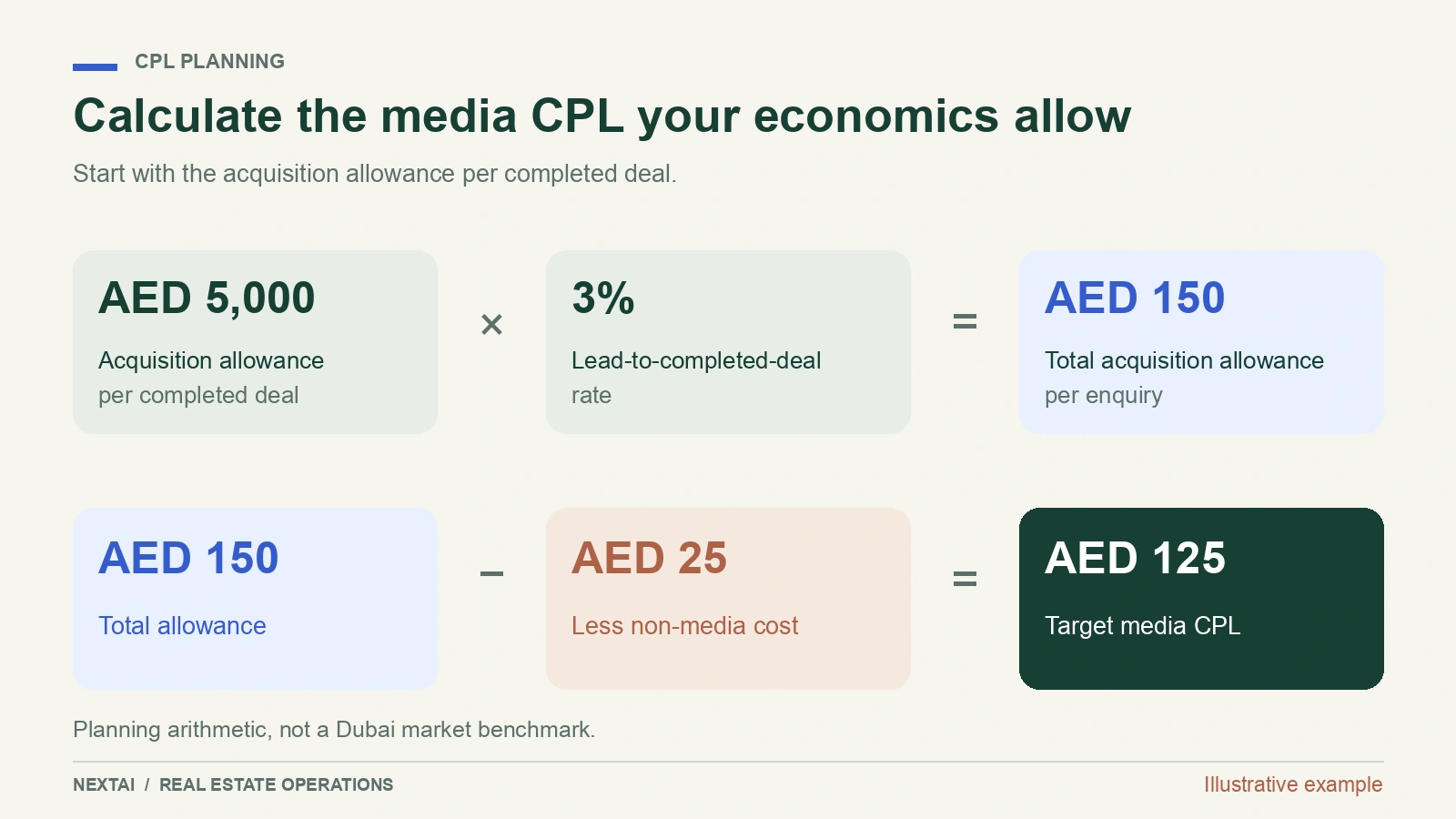
Hypothetical calculation: AED 5,000 acquisition allowance × 3% completed-deal rate, less AED 25 non-media acquisition cost, gives AED 125 target media CPL.
This is a planning limit under the stated assumptions. Spending AED 125 does not guarantee a profit. Costs can change, deals can fall through and a small sample can misrepresent the next cohort.
If you have no measured conversion rate, use a provisional range and cap the experiment. Do not turn your sales manager's most optimistic estimate into a permanent bidding target.
Test the assumption that moves the answer most
For an agency with the same AED 5,000 allowance and AED 25 non-media acquisition cost, the ceiling changes sharply with the completed-deal rate.
| Hypothetical lead-to-deal rate | Total allowance per enquiry | Target media CPL |
|---|---|---|
| 1% | AED 50 | AED 25 |
| 2% | AED 100 | AED 75 |
| 3% | AED 150 | AED 125 |
| 4% | AED 200 | AED 175 |
The 1% and 4% scenarios describe different economics. Choosing between them needs evidence from your records. One deal from 25 leads is not enough to assume the next 25 will behave identically.
Take completed cohorts from comparable inventory and campaigns. Include invalid enquiries in the raw paid-lead denominator if the campaign charged you to generate them. Report qualification separately so quality problems remain visible.
For deduplicated management reporting, also calculate cost per unique prospect. Label it explicitly. Your external media CPL and internal unique-prospect CPL may differ because one person submitted several enquiries; neither should silently replace the other.
Compare campaigns at the same stage
A lower media CPL can buy fewer completed deals for the same spend. Compare downstream results before moving budget.
Consider two hypothetical campaigns with mature outcomes:
| Metric | Campaign A | Campaign B |
|---|---|---|
| Media spend | AED 20,000 | AED 20,000 |
| Enquiries | 200 | 100 |
| Media CPL | AED 100 | AED 200 |
| Completed deals | 2 | 4 |
| Media cost per completed deal | AED 10,000 | AED 5,000 |
Campaign B has the higher CPL and the lower cost per completed deal. It still needs the contribution calculation: AED 5,000 media cost may exceed its total acquisition allowance after management and creative costs.
Before attributing the difference to targeting, compare enquiry handling. Did both groups receive timely contact? Were suitable properties available? An unattended queue can make a sound campaign appear weak. The enquiry-to-viewing tracking model provides the intermediate stages needed to inspect that question.
Allow time for property enquiries to mature
Compare outcomes for leads acquired in the same period, then mark how long each cohort has been observed. Dividing this month's advertising spend by this month's completions can mix newly acquired enquiries with deals won from much older campaigns.
Google's conversion lag reporting explains why delayed conversions can make recent cost-per-acquisition figures look higher before outcomes arrive. Your agency's collected-commission report can lag further still. Choose a review horizon using your own enquiry-to-completion and payment history.
Until deals mature, watch contact, qualification and attended-viewing rates. These are early signals. Do not count an appointment as revenue or assume every campaign has the same viewing-to-deal rate.
Google supports qualified and converted lead goals based on a business's own stages. If you import qualified prospects or attended viewings into Ads, name the event precisely and keep the completed-deal report alongside it. A bidding signal and an accounting outcome serve different decisions.
Put the limit into an owner-approved budget decision
Write a one-page decision before launching or expanding a campaign. Include the property segment, acquisition allowance per completed deal, assumed conversion range and target media CPL. Record which costs are included and who will verify the numbers.
Set a review trigger that fits your budget and expected sales cycle. For example, an owner might authorise a fixed test spend, require an early review of invalid enquiries, then defer the profitability verdict until the first cohort has had time to complete. The amount and observation period must come from that agency's capacity and history.
If the campaign exceeds its provisional ceiling, inspect where the model diverged: media price, enquiry quality, agent handling, stock fit or retained contribution. Avoid repeatedly raising the ceiling to excuse poor results.
A Google Ads review for a Dubai agency should begin with this worksheet of assumptions and actual outcomes. The useful question for the next budget meeting is specific: at the contribution your agency keeps, how many of these enquiries must complete for the proposed spend to make sense?
PUT IT TO WORK
Set a defensible acquisition budget
Review your campaign spending against retained commission, qualified enquiries and completed deals.
Discuss your agency’s workflow Explore the service