
Buy a real estate CRM only after someone demonstrates your agency's daily work on realistic test records. A feature list cannot tell you whether one buyer can enquire about several properties, whether reassignment preserves their conversation, or whether you can leave with usable data.
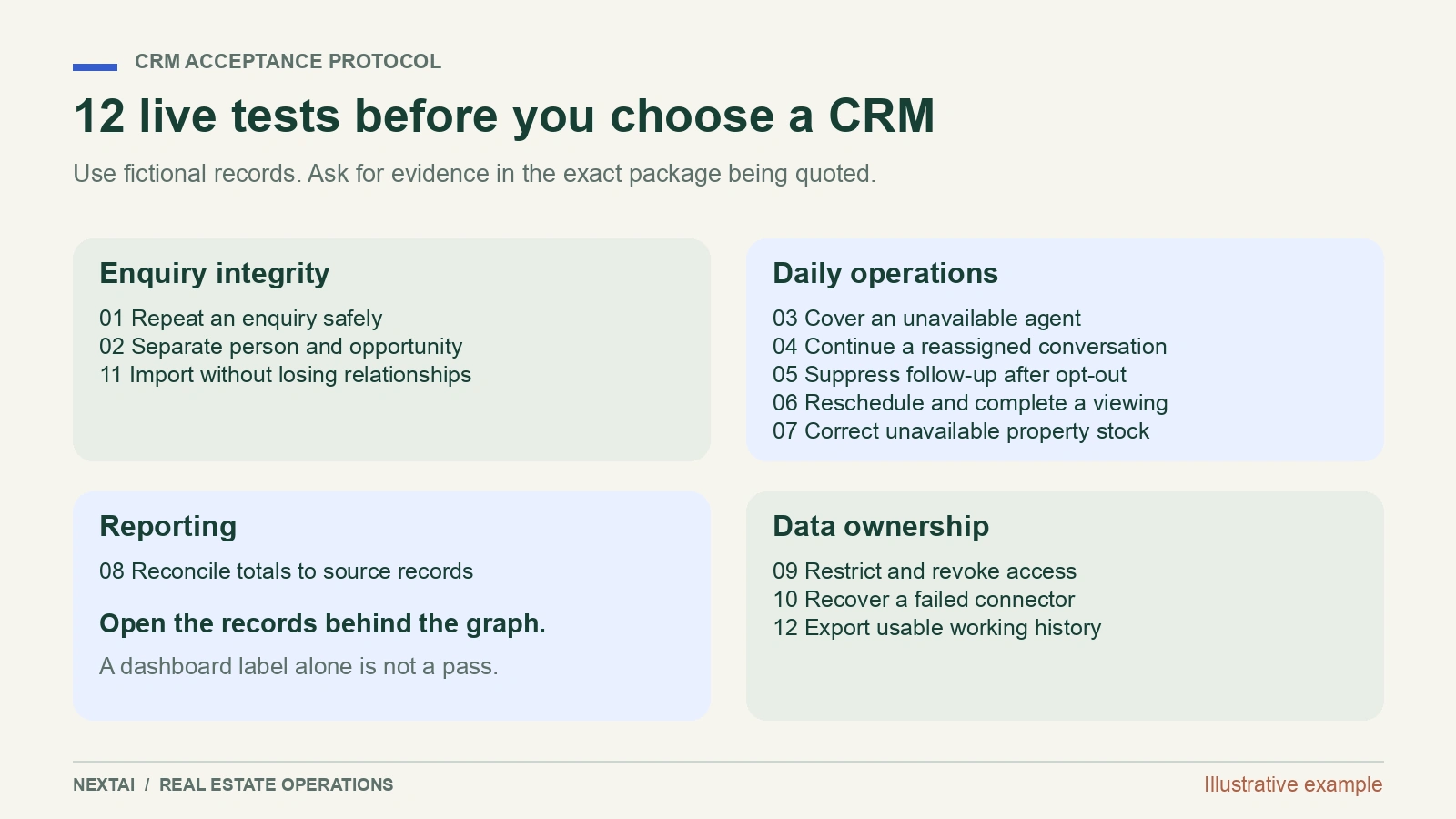
Use these 12 acceptance tests in the demonstration. They are a proposed buying protocol, not results from a product comparison. Mark each test passed, failed or dependent on additional configuration, and attach the evidence to the quoted package.
Bring a small fictional agency into the demo
Prepare fictional records for two agents, their manager, several properties and a handful of prospects. Include a Dubai buyer asking about two units, an Abu Dhabi enquiry outside one team's coverage, and an overseas buyer requesting a video appointment.
Use test accounts and messages, with phone numbers and email addresses controlled by your agency or provided for testing by the vendor. A made-up phone number may belong to someone. Do not upload your production buyer database to an unapproved trial. Ask the vendor to work within the subscription tier they are quoting, including any paid connectors.
Record the configuration, product edition and date. A capability demonstrated in an administrator's environment may require permissions or an add-on absent from your purchase.
1. Repeat an enquiry without losing the original
Submit the same controlled test phone number twice, once in international format and once in the local format your staff receive. Add a second property enquiry for that person.
Pass when the system handles identity according to your agreed rule, preserves both enquiry histories and avoids a silent overwrite of the original source. It must also provide a review route for an ambiguous match. Shared household numbers make automatic merging a business decision.
Ask the demonstrator to undo an incorrect merge or explain the supported recovery procedure. Record any data that cannot be restored.
2. Separate the person from the property opportunity
Give one buyer a rental requirement and a separate purchase enquiry. Close the rental opportunity while keeping the purchase active.
Pass when the contact remains intact and each opportunity retains its own budget, property links, stage and source. Open the buyer record and check that an agent can understand both conversations without mistaking a closed rental for a lost buyer.
Do the reverse, too: link several prospects to one property without exposing their private notes to one another.
3. Assign a lead while the preferred agent is unavailable
Mark the usual agent unavailable, then create an enquiry in their area. Demonstrate the fallback, notification and acceptance process.
Pass when a named person owns the lead and the manager can see any unaccepted work. Restore the original agent's availability and confirm that the lead does not jump between agents unexpectedly.
Specify what happens overnight or when every eligible agent is busy. “Round robin” is incomplete unless those cases have an answer.
4. Continue a conversation after reassignment
Use the proposed WhatsApp connection to receive a test message, assign the conversation, reply and transfer it. Sign in as the receiving agent.
Pass when that agent sees the authorised conversation context, the requested property and the next action. Verify what happens to attachments and messages sent outside the CRM. Ask which parts are synchronised automatically and which require staff entry.
If the integration uses the WhatsApp Business Platform, test an out-of-window message as well. Meta requires approved templates outside the customer service window, which runs for 24 hours after the user's last message. WhatsApp Business Messaging Policy.
5. Suppress follow-up after an opt-out
Queue a follow-up, record the test contact's request to stop, then attempt to run the queued action. Repeat after reassignment.
Pass when the applicable communication is suppressed and staff can see why. Ask how the integration handles an opt-out received through another channel. Meta's policy requires businesses to respect requests to discontinue WhatsApp communications, including requests made outside WhatsApp. WhatsApp policy on opt-outs.
This checks system behaviour. Your agency still needs to define which permission and retention rules apply to its activities.
6. Book, reschedule and complete a viewing
Offer a time for a ready property, record acceptance, then reschedule it. Use an overseas test prospect to inspect the displayed timezone and meeting details.
Pass when the old appointment is clearly superseded, reminders follow the current booking and a manager can distinguish proposed, confirmed and completed viewings. Link access confirmation to the appointment if your team depends on a landlord or building contact.
For off-plan enquiries, demonstrate a project consultation as a separate appointment type.
7. Correct stale property availability
Change a test unit from available to unavailable while a follow-up task exists. Ask the agent to send a property suggestion.
Pass when the system exposes the current availability and lets the agent offer an alternative without erasing the buyer's original interest. If inventory is synchronised externally, demonstrate a failed update and its visible warning.
Write down which system owns availability and how an authorised person corrects a conflict. An attractive property card with stale information is an operational liability.
8. Reconcile a report to the underlying records
Create known examples of a new enquiry, a duplicate, a qualified opportunity and a completed appointment. Have the vendor build your campaign report from them.
Pass when you can open the records behind each total and explain its date rule. Reopen a qualified opportunity and verify that it does not become a second acquired buyer unless your definition explicitly calls for that.
Use the WhatsApp measurement definitions to specify the report before the demo. A graph labelled “leads” is insufficient evidence.
9. Restrict an agent's access and then remove it
Sign in as an ordinary agent and attempt to open another team's restricted records, export contacts and change assignment rules. Remove the test user's access, then try their existing session again.
Pass when the behaviour matches the permissions your agency agreed, including access through mobile apps or connected services. Ask how quickly revocation takes effect and what audit history remains.
Request documentation covering data hosting, subprocessors, backups and deletion. Treat these as supplier questions requiring documented answers for your agency, rather than assuming a “UAE ready” label establishes compliance.
10. Break a connector without losing the lead
In the trial, have the vendor simulate a disconnected inbox or rejected integration request. Submit a marked test enquiry.
Pass when a named operator can identify the failure, find the affected record and recover it. Repeat the failed operation and check that it does not create another lead or send the same reply twice.
Record who monitors failures, whether alerts cost extra and what support covers. The automation prioritisation method explains why this affects the business case.
11. Import changes without destroying relationships
Import the fictional records, then import an update to an existing buyer and their linked opportunity. Preserve original identifiers in your test file.
Pass when the update changes the intended fields and retains relationships and history. Vendor rules differ: HubSpot, for example, documents unique identifiers for matching records and specific association behaviour. Use its documentation as evidence that import details require inspection, not as an assumption about another CRM. HubSpot multiple-object import guidance.
Ask for a preview, error report and recovery method before importing production data.
12. Export enough data to operate elsewhere
Request an export of your fictional contacts, opportunities, appointments and activity history. Include property relationships, custom fields and attachments, or a documented retrieval method for files.
Pass when a colleague can reconstruct which buyer wanted which property and what action remains due. Inspect the files themselves. A contact CSV alone cannot establish portability of the agency's working history.
Get written answers about export permissions, fees, cancellation access and available formats. These are contractual terms to confirm for the specific offer.
Make the failed tests part of the buying decision
Treat an unproven mandatory workflow as unfinished evaluation. A promised fix needs a named deliverable, price and retest date before you rely on it.
Compare the total first-year implementation scope: subscription, migration, connectors, training and support. Avoid selecting a product solely because it passed the easiest demonstration.
NextAI's CRM and automation work can begin with these acceptance criteria. For UAE real estate agencies, the purchase should end with a documented operating workflow and evidence that the team can use it.
PUT IT TO WORK
Define your CRM acceptance criteria
Turn your agency’s enquiry and viewing process into a concrete CRM specification before choosing software or commissioning a build.
Discuss your agency’s workflow Explore the service