
Build the automation that removes a frequent, measurable problem and has a workable recovery path when it fails. For a UAE real estate agency, that may be an unassigned-lead alert or a viewing reminder. It may also be no automation yet, if the team has not agreed who owns the task or which property data is current.
Use two decisions. First, establish whether a workflow is ready to automate. Then compare its expected value with implementation and operating costs. A high revenue estimate should not hide an uncontrolled customer-facing action.
Reject unclear workflows before scoring them
Describe the proposed automation in one sentence that names its trigger, action and completion evidence. For example: “When a new enquiry remains unaccepted past our coverage target, notify the duty manager and show it in the exception queue.”
That description leaves several decisions to settle. When does the clock run? Who covers evenings? Does the alert transfer ownership or only request intervention? What happens when a named agent is already speaking to the prospect?
Until the team can answer, the project contains an unresolved operating policy. Software will make that ambiguity run more often.
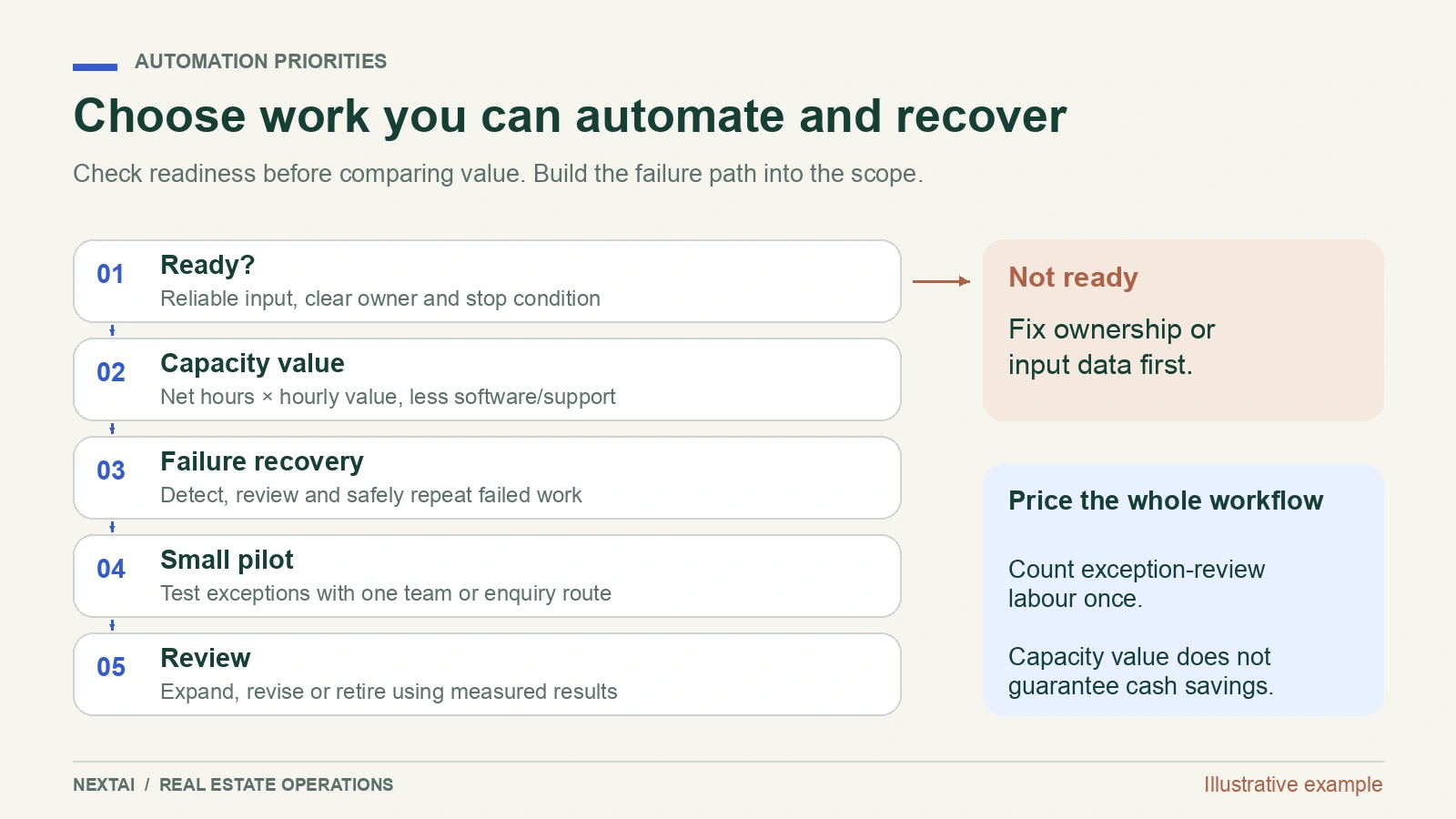
Apply four readiness checks:
- The input exists in a system the agency can access reliably.
- A named employee owns the result and any exception.
- The action has a defined stop condition.
- The team can identify and repair an incorrect outcome.
For customer messages, add the relevant permission and messaging requirements to the workflow. WhatsApp Business Platform automation must respect its messaging rules, including approved templates outside the 24-hour customer service window and available escalation paths. WhatsApp Business Messaging Policy.
Compare costs only for workflows that pass these checks.
Compare candidates using the same unit of value
Estimate each workflow's monthly effort saving from observed task volume and handling time. Record gross task hours removed, then subtract the hours still needed for exception review. Measure a short sample of actual work, including interruptions and rework, before committing money.
A useful planning calculation is:
Net monthly capacity value = (gross task hours removed - exception-review hours) × internal hourly value - recurring software and support costs.
This is capacity value, not guaranteed cash saving. If the agency will continue paying the same salaries, state what the recovered time should enable. It might increase coverage during viewings or remove evening spreadsheet reconciliation.
Count exception-review labour once: the formula already deducts it from the hours released. Add software and support fees as monetary costs, without charging for the same labour again. Include mapping, testing and training in the build cost. Keep speculative commission gains in a separate scenario until you have evidence connecting the workflow to completed transactions.
| Candidate | Evidence to collect | Cost often omitted | Failure to plan for |
|---|---|---|---|
| Unaccepted enquiry alert | Missed ownership events and manager checking time | Maintaining agent coverage | Alert goes to someone unavailable |
| Viewing reminder | Manual reminders and appointment changes | Monitoring delivery and cancellations | Reminder sends for a cancelled booking |
| Daily source report | Time reconciling records and correcting totals | Maintaining field definitions | Missing records quietly lower a campaign total |
| Property suggestion message | Repeated matching work | Reviewing availability and exceptions | An unavailable unit is offered |
For reporting projects, agree the lead and appointment definitions first. Automatically producing an ambiguous report saves the wrong work.
A worked decision with no promised revenue uplift
Consider a hypothetical agency comparing an internal lead alert with an automated property recommendation message. All figures below are illustrative planning inputs, not quoted NextAI prices or market benchmarks.
The alert is expected to remove 18 hours of monthly checking. The owner values that capacity at AED 100 per hour. Software and support cost AED 300 monthly, while two hours of exception review cost another AED 200 on the same basis.
Its estimated net monthly capacity value is therefore AED 1,300: (18 - 2) × AED 100, less AED 300 in software and support. With an illustrative build cost of AED 5,200, simple payback on that valuation would be four months.
That result depends on releasing the hours. If the manager continues performing all the original checks, the estimate fails. Assign an operational change alongside the software delivery.
The recommendation workflow might appear more valuable because it could influence sales. Yet the agency has no reliable availability feed and no record of how many lost deals stem from slow suggestions. Its revenue benefit is unmeasured, and its errors reach prospects directly.
The sensible first step is to improve availability records and let staff review suggested matches. The internal alert can proceed if its acceptance tests pass. This decision preserves the larger idea while avoiding a business case built on an unsupported commission estimate.
Write the failure behaviour beside the intended action
Every proposed automation needs a short operational record. It should name the trigger, required data, action and owner. Add what happens when the data is missing, when a service rejects the request and when the same event arrives again.
Repeated events deserve explicit treatment. If a reminder request is processed twice, the second attempt should recognise that the appointment's reminder has already been handled. Developers often call this idempotency: repeating an operation has the same intended effect as doing it once.
A successful request also needs careful interpretation. A messaging service accepting a request is not the same as the recipient receiving or reading it. Decide what evidence marks your workflow complete and which delivery failures create a staff task.
For a viewing reminder, write these example rules before implementation:
- Recheck the appointment's current status and scheduled time immediately before sending.
- Suppress the action if it was cancelled, superseded or excluded by the contact's communication settings.
- Record the attempt against the appointment so a repeated trigger cannot blindly send another message.
- Place unresolved delivery errors in a queue with a named owner and the permitted next action.
If a send times out after the external service may have accepted it, establish a reconciliation procedure before retrying. “Retry every failure” can produce duplicate customer messages.
Prefer review where an error changes the promise
An internal alert can usually be dismissed or corrected cheaply. A message confirming an unavailable unit or an unapproved viewing slot creates a promise that an agent must repair.
Start those workflows in review mode: the system drafts or suggests, and an authorised employee approves the action. Give the reviewer the current availability record and its update time. Approval without the evidence simply moves the uncertainty onto a button.
AI-based classification needs similar controls. Test abbreviated messages, mixed languages and changes of requirement using fictional or appropriately authorised examples. Record disagreements between the suggested classification and a staff decision. Do not silently discard a buyer because a model inferred a budget or transaction type incorrectly.
Keep financial commitments, contractual changes and other consequential decisions under a clearly defined human authority. This is a proposed operating boundary for the workflow, not a statement that any particular software provides it automatically.
Pilot with a stop rule and a recovery drill
Choose one team or enquiry route for the pilot. Record the current task time and error count, then compare the same measures after launch. Note changes in enquiry volume and staff coverage that could explain the difference.
Test the unwanted paths deliberately: missing owner, cancelled appointment, repeated event and disconnected service. Include an interruption during processing. Someone other than the builder should recover a marked test case using the operating instructions.
Agree the stop rule in advance. For example, pause outbound reminders immediately if one is sent for a cancelled appointment, investigate the cause and replay the corrected test before resuming. That is an illustrative control the agency can adopt, not an industry threshold.
At the review, decide whether to expand, revise or retire the workflow. Use measured effort saved, exceptions created and recovery time. If it creates a daily queue nobody clears, include that cost honestly.
Our CRM and automation service starts from this kind of scoped workflow. Bring the recurring task, a few representative records and the person who owns exceptions. The first useful deliverable is an automation the agency can operate when the builder is unavailable.
PUT IT TO WORK
Choose one automation worth operating
Work with NextAI to define a measurable workflow, its acceptance tests and the staff process for handling failures.
Discuss your agency’s workflow Explore the service