
If your UAE property ads generate leads but few viewings, find the first stage where genuine prospects stop progressing. Separate unanswered enquiries, unsuitable requirements, unavailable stock and failed bookings. Each needs a different fix. A lower cost per lead will not repair a viewing request that nobody confirms.
Start with one campaign and an enquiry cohort: people who first contacted you during the same period. Allow enough observation time for their viewings to occur, and show future appointments as pending. Keep ready-property enquiries separate from off-plan enquiries, where a sales consultation or showroom appointment may be the relevant next step.
Reconstruct the journey before blaming the campaign
Keep one record per genuine enquiry, including the original listing reference, contact time, first human response and current outcome. Link repeat enquiries to the same buyer. For the diagnostic funnel, count distinct prospects reaching each stage; retain individual enquiries and appointments for investigating the losses.
Use the following stages as working definitions. Your team can adjust them, but everyone must apply the same rules.
| Stage | Evidence needed | Common reporting mistake |
|---|---|---|
| Enquiry received | A form or actual incoming message | Counting a WhatsApp button click |
| Conversation started | A two-way exchange with the prospect | Counting an automated greeting |
| Suitable requirement | Budget, property need and timing match an offer you can serve | Calling anyone who replies qualified |
| Viewing proposed | A specific property and available slot were offered | Writing “follow-up sent” |
| Viewing booked | The prospect accepted a slot and access was confirmed | Counting an unanswered calendar invitation |
| Viewing attended | Attendance was recorded | Treating every booking as completed |
For the initial audit, choose a manageable batch that includes successes and failures. Do not let each agent submit only their worst leads. Inspect the actual message history where access is authorised, rather than relying on a “bad quality” label.
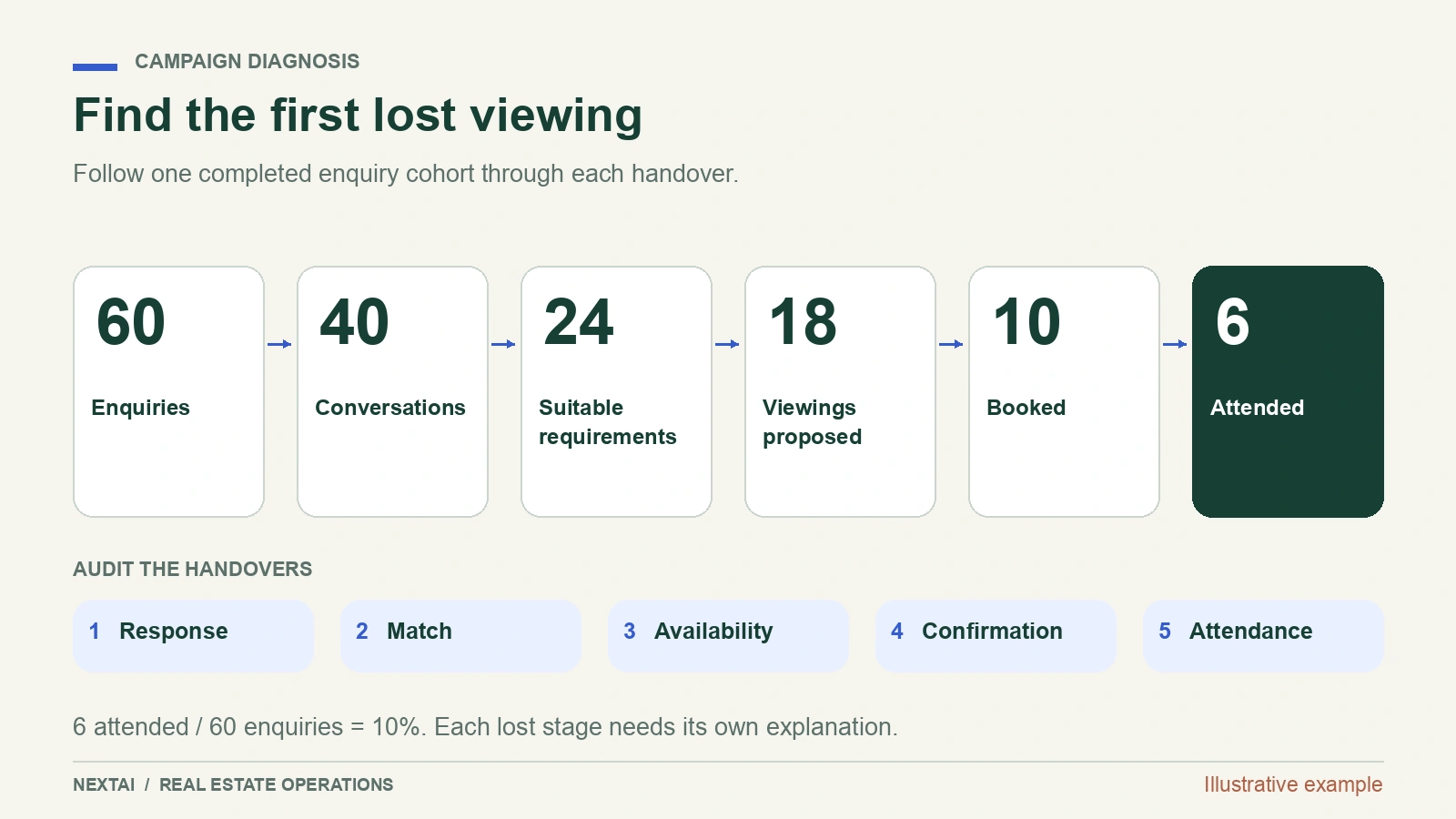
A small cohort can reveal a very specific failure
Consider this hypothetical ready-property campaign in Dubai. It produced enquiries from 60 distinct prospects in a selected period. Each booked at most one viewing in this example. These are invented figures to illustrate the method, not UAE performance benchmarks.
Forty prospects entered a conversation. Twenty-four had suitable requirements. Eighteen received a viewing proposal, ten accepted and six attended.
Six of the 60 prospects attended, giving a 10% prospect-to-attendance rate. The total hides several questions. What happened to the 20 people without a conversation? Why did six suitable prospects receive no proposal? Which four confirmed appointments did not happen?
Suppose the message audit finds that five of those six suitable prospects wanted the advertised building, but access was unavailable. Adding broader targeting would not solve that particular loss. The listing and operations teams must establish which units can actually be shown.
Now suppose the uncontacted group mostly arrived while the assigned agents were conducting viewings. That points towards coverage and reassignment. It does not establish that the audience was poor.
Keep the denominator visible. “Six attended out of ten bookings” describes appointment completion; “six prospects attended out of 60” describes the whole journey. If someone attends several viewings, count them once in the prospect funnel and retain each appointment in the diary report.
If conversations reveal the wrong requirement, inspect the promise
Repeated mismatches give you a testable explanation for weak lead quality. Classify them precisely: rental enquiry on a sales campaign, incompatible budget, a different emirate, or a moving date your stock cannot support. Keep “unknown” for people who never answered.
For Google Search campaigns, compare those reasons with actual search terms and the landing page shown. Google's search terms report describes the searches that triggered ads, but omits some low-volume queries for privacy. Treat it as partial evidence, not a complete record of every visitor's intent. Google Ads search terms documentation.
A hypothetical advertisement for an apartment “from AED 1.2 million” may attract people whose total budget is AED 1.2 million. If the available configuration they want costs more, the lead has responded reasonably to the advertised entry point. Show the relevant configuration and current availability clearly.
Check whether the page explains ready versus off-plan status, location, property type and what the next conversation will establish. When the same misunderstanding appears repeatedly, revise that specific promise. Our property landing page service addresses this handover between an advertisement and an enquiry.
Do not exclude a whole country because one overseas prospect could not visit this week. Separate current location from purchase timing and the option of a remote appointment.
If suitable buyers stall, inspect what agents can offer
A suitable buyer needs an actionable next step. “When are you free?” creates another exchange without establishing that a property can be accessed.
Review the last agent message before each stalled conversation. Was it a long property catalogue? A request for information already supplied? A promise to check availability that nobody completed? Record the specific obstacle.
For a ready apartment, an illustrative proposal might read: “The two-bedroom you asked about is available to view on Tuesday at 18:00 or Wednesday at 11:00 UAE time. Which suits you? I will send the meeting point once we confirm.” Send this only after checking access.
A buyer currently abroad may prefer a video viewing. Record that separately from an in-person viewing so your attendance numbers retain meaning. A completed video tour also should not imply that the buyer has inspected every physical detail.
Give the manager an exception list: suitable prospects without an offered appointment, proposed slots waiting for access approval, and confirmed bookings without meeting instructions. Assign a named person to clear each exception. If ownership repeatedly goes missing, the next fix belongs in the CRM and automation workflow.
If bookings fail, examine the appointment itself
A no-show can be a booking problem even when the original lead was relevant. Check the accepted date and timezone, exact meeting location, access arrangements and whether the prospect cancelled in another conversation.
Use specific outcomes: cancelled by prospect, cancelled because access failed, rescheduled, agent unavailable, or unexplained absence. Rescheduling creates a new appointment record linked to the same enquiry. It should not create another qualified lead.
Compare like with like before drawing conclusions. A new cohort may have future appointments pending. A luxury sales campaign and a short-notice rental campaign also need different maturation periods. Choose your reporting cutoff from the actual appointment cycle and show pending appointments separately.
Change the constraint, then measure it again
Choose one correction linked to the largest evidenced loss. Examples include clearer price context, backup assignment during viewings, or checking access before offering a slot. Write the expected change before implementation: “More suitable prospects should receive an available viewing proposal.”
Keep the audience and reporting definitions stable enough to interpret the next cohort. Record any simultaneous stock or budget changes. Small numbers can suggest where to investigate; they cannot establish that one change caused an improvement.
Check what the advertising account treats as success, too. Google Ads generally uses primary conversion actions for bidding when their standard goal is selected; secondary actions are observational, with an exception for custom goals. Review the actual configuration before replacing a click goal with a downstream event. Google's conversion action guidance.
Use the WhatsApp measurement definitions to separate clicks from enquiries. Then brief your Google Ads team with the observed failure, the records behind it and the result you expect. “Five suitable buyers could not access the advertised units” is a problem someone can fix.
PUT IT TO WORK
Find the step losing your property enquiries
Review the campaign, listing promise and lead handover with NextAI to identify a specific change worth testing.
Discuss your agency’s workflow Explore the service